Why Oil Prices Are About to Make Your Vibrator More Expensive
Hi babes!
It's your favorite policy nerd, Polly! Hi! Hello!
Never in a million years did I think I'd be using my economics degree to explain the vibrator material and freight cost increases as a result of a war we started in the Middle East... but it is the year 2026 and every day is a new HELL adventure!
When the Trump administration decided to blockade the Strait of Hormuz off the coast of Iran, they also cut off 20% of the global oil supply to the world, and notably, to China where 80% of the world's sex toys are manufactured. Approximately 54% of China's crude and condensate imports come from the Middle East, with a substantial portion flowing through the Strait of Hormuz, making it vulnerable to regional conflict (Source: Reuters).
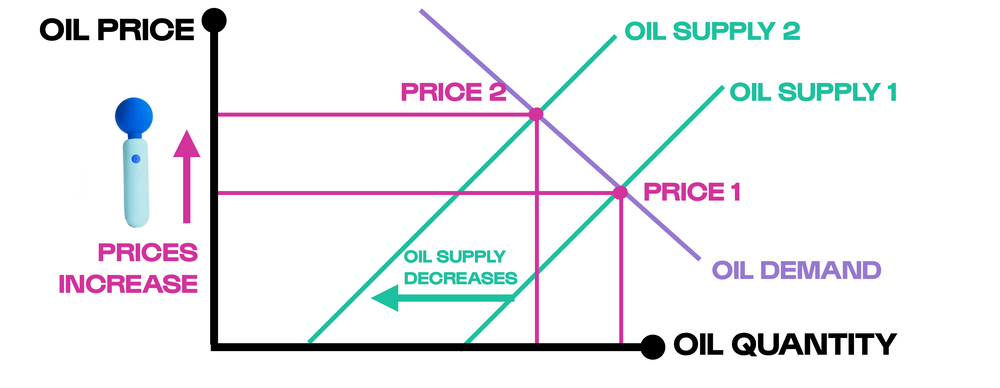
When we decrease the supply of any good, while demand remains constant, the price goes up. This is the most basic and true fundamental economic concept: the point on a graph where supply = demand is where you'll find the price for a given quantity of goods. If either supply or demand change, the price changes as a result of either a shortage or a surplus. Right now, we're in a helluva shortage with 1/5 of the global supply being removed from the market overnight (voluntarily, no less!!!).

At the highest level, it's important to know that oil isn't just fuel that goes into your neighbor's F-150 pickup with the Truck Nuts hanging off the trailer hitch. Crude oil is used at every level of manufacturing. Petrochemicals from oil become the building block elements for plastics, silicones, synthetic rubber, coatings, and even parts of electronics -- materials often used in the manufacturing process for vibrators, dildos and plugs. In fact, over 90% of plastics originate from fossil fuels like oil and gas (Source: Rapid Manufacturing).
THE MATERIAL COST INCREASES
At Unbound, almost every material we manufacture depends on oil production. Trust us, we wish that was not the case -- but until we, collectively as a country, decide to invest in more sustainable energy, we are ALL wholly dependent on oil and gas.
To give you an understanding of how this impacts the cost of the material components at Unbound:
- Body safe silicone: Is made using petrochemicals derived from crude oil. Specifically, silicone production relies on hydrocarbon-derived intermediates and energy-intensive processing. So while silicone isn't made of oil, it is made using oil.
- Plastic enclosures: In order for vibrators to be waterproof and safe, the motor and electronics of each vibe are often housed in a plastic enclosure to protect the components from getting wet and malfunctioning. Plastics are made from ethylene and propylene derived from crude oil (i.e., oil is literally the backbone of plastic resin).
- Motors: Each vibrator contains a motor with a counterweight that creates the vibration sensation. Motors may seem mechanical, but the lubricants needed to keep the motor running smoothly are petroleum-based. The insulation for the motors uses petrochemicals in production as well
- PCB boards: These small electronic boards connect the buttons on your vibrator to the motor and function as the brain, telling the vibrator to turn on or off and cycle through different settings. While it's a bit less obvious, PCB laminates use epoxy resins which are petrochemical-derived; along with solder coatings and adhesives to ensure it's securely placed in the vibrator
- Charging cords and wires: Last, but not least, the plastic insulation used on wires and the charging cords for the vibrator itself are all made from plastic like PVC and PE which are oil-derived

Oil is embedded in nearly every component we produce. From plastic housings to wire insulation to the coatings on our circuit boards, rising oil prices increase the cost of making our vibrators before we even ship them.
However, once we do go to ship our vibrators, dildos, and accessories, we are faced with an entire second wave of cost increases: shipping and logistics.
THE SHIPPING COST INCREASES
Fuel is needed to transport everything and it's one of the biggest cost drivers in shipping and transit costs. Whether you are shipping inventory via sea, air or truck; fuel is a major operating cost across all transport modes. Ships require bunker fuel, planes require jet fuel, and trucks require diesel gasoline - all of which are oil derived.
Once inventory is completed by our manufacturers, there are only three ways to ship it to the United States and our customers:
- Sea freight: Historically, sea freight is the more affordable option for shipping inventory from China to the United States. It takes much longer, sometimes as much as 60-70 days, but the space on a ship is much cheaper than space on a plane. Unfortunately, fuel comprises 30-60% of a ship's operating costs so when the cost of fuel increases, sea freight costs increase dramatically. Since the Strait of Hormuz has closed, many freight forwarders are now adding surcharge fees to account for the cost increase in fuel. A Bunker Adjustment Factor is added to invoices as a fuel surcharge during times of acute cost increases, like what we're facing now.
- Air freight: With the disruptions in the global supply chain, brands will sometimes choose to air freight their products to the United States via plane, which is much faster but also much more expensive. Currently, air freight costs are increasing by the week and jet fuel accounts for ~30% of airline operating expenses.
- Truck freight: Once the inventory arrives at the LA or NY port, it is then transported via truck to our warehouse and then again by truck via 3rd party carriers (e.g., UPS, USPS, DHL). As of now, fuel costs are reflecting a 25% increase in just three weeks during March/April. Fuel accounts for up to 40% of trucking operating costs.
The cost increases in fuel have resulted in dramatic cost increases for shipping inventory from China to our warehouse in Pennsylvania:
- Fuel surcharges have jumped from ~28% to as high as 52%
- Fuel-driven fees can add an additional 5–15% to total shipping costs
-
Carriers are adding emergency surcharges of 10-12% to cover the increased costs of fuel

Sources:
Rising Fuel Costs and Their Impact on Global Freight
How 2026 Fuel Increases Might Impact Your Transportation Costs
Freight Industry Outlook 2026: What Trucking Companies Should Expect
This chart shows why your next plane ticket will likely be way more expensive
IN SUMMARY
20% of the world's oil supply passes through the Strait of Hormuz, meaning 1/5 of the oil supply has been removed from the market. This creates disruption through immediate oil price spikes which then have cascading effects:
- Raw material costs increase
- Factory energy costs increase
- Shipping fuel costs surge
- Freight rates, surcharges, and fees increase
- Lead times and supply chain volatility increase
When oil supply is disrupted, businesses like Unbound are hit twice. First, in the cost of making our products, because oil is embedded in the materials themselves. Then again in the cost of shipping our products, because oil powers the ships, planes, and trucks that deliver them.
OUR PROMISE TO YOU
While we don't know what the landed cost increases will be yet, we are working extremely closely with our manufacturers and their sourcing teams to try and limit those increases. However, like most things that involve the global supply chain, so much of it is out of our hands.
However, in the event we do need to increase our prices as a result of the cost increases in materials and fuel, we promise to provide all our customers with at least two weeks' notice of what those cost increases will be.
As always, it is our sincere hope that we will be able to weather one more storm and keep prices affordable, because we know how stretched EVERYONE is feeling right now financially, and it's never our aim to contribute to your stress.

Latest Articles




Lube Me Tender: Water-Based vs. Silicone Lubricant